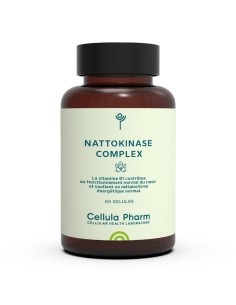
Nattokinase: the enzyme derived from a Japanese tradition

Fermented soy with an enzyme that is now being studied by science.

Natto is a traditional Japanese food made by fermenting soybeans. Its particular texture and pronounced taste make it an emblematic food of the Japanese food culture.

It is during this fermentation, carried out using the bacterium Bacillus subtilis var. natto, what an enzyme called nattokinase is produced.

Discovered and isolated in the 1980s, nattokinase has since been the subject of scientific research, particularly to better understand its enzymatic activity, fibrinolytic activity, and behavior after ingestion.

Magnésium - Sommaire

Content

  1. What is nattokinase?
  2. From natto to nattokinase: how is it obtained?
  3. How does fibrinolysis work?
  4. What does FU mean on a label?
  5. Nattokinase and Vitamin K2: what’s the difference?
  6. Why is nattokinase being studied?
  7. How do you compare two nattokinases?
  8. In which formula does Phron Pharm use nattokinase?
  9. To remember

1. What is Nattokinase?

Une enzyme issue de la fermentation du soja

Nattokinase is a proteolytic enzyme produced during the fermentation of soybeans used to make natto.

It belongs to the family of serine proteases and is also known as NAT subtilisin.

Contrary to what its name might suggest, nattokinase is therefore neither a vitamin nor a mineral or a compound naturally present in large quantities in unfermented soybeans.

It results from the activity of the bacteria used during fermentation.

To know

Origin: natto, traditional Japanese food
Raw material: fermented soybeans
Microorganism: Bacillus subtilis var. natto
Nature: proteolytic enzyme
Activity: expressed as FU (Fibrinolytic Units)

D'ou vient l'huile d'argousier

2. From natto to nattokinase: how is it obtained?

It all starts with a soybean seed.

1—THE SOY BEAN

Soybeans are the traditional raw material used to make natto.

2—THE FERMENTATION

The seeds are fermented using Bacillus subtilis var. natto.

The bacterium then transforms the medium and produces various substances, including enzymes.

3—NATTOKINASE

Nattokinase is one of the enzymes produced during this fermentation.

4—EXTRACTION AND STANDARDIZATION

To be used in a food supplement, nattokinase can be isolated and then standardized according to its enzymatic activity.

This is where the FU comes in, and it’s an essential part of understanding food supplements that contain nattokinase.

3. How does fibrinolysis work?

During coagulation, the body produces fibrin. It forms a network that participates in the clot’s structure.

But the body also has mechanisms to gradually degrade this fibrin when it is no longer needed.

This process is called:

Fibrinolysis

Clot formation

Fibrin network formation

Activation of the physiological mechanisms of fibrinolysis

Progressive degradation of fibrin

Nattokinase is being studied experimentally for its fibrinolytic activity, which explains the scientific interest in this enzyme.

4. What does "FU" mean on a label?

FU = Fibrinolytic Units

FUs, or fibrinolytic units, express nattokinase enzyme activity.

For an enzyme, looking only at its weight in milligrams does not necessarily reveal its activity level.

Two raw materials can have the same weight without necessarily having the same enzymatic activity.

Exemple :

100 mg of nattokinase

does not provide all the information on its own.

It’s also interesting to look at:

→ the quantity in mg
→ the activity expressed in FU

To know

To compare two supplements containing nattokinase, it is particularly useful to look at the enzymatic activity expressed as FU and not just the number of milligrams reported.

D'ou vient l'huile d'argousier

5. Nattokinase and Vitamin K2: what’s the difference?

Confusion is common because natto is also known for its vitamin K2 content.

Yet these are two completely different substances.

--

Nattokinase

Nature: enzyme
Produced during: fermentation
Activity: enzymatic
Measurement: FU

Vitamin K2

strong>Nature: liposoluble vitamin
Family: vitamin K
Nutritional role: contributes in particular to normal blood clotting and the maintenance of normal bone structure.

-

In fact, a nattokinase extract can be made to have very low or controlled levels of vitamin K2 depending on the raw material used.

So natto, nattokinase, and vitamin K2 should not be confused.

6. Why is nattokinase being studied?

Nattokinase is the subject of research in humans, particularly around fibrinolysis and coagulation parameters, but also certain cardiovascular parameters.

However, not all available studies are equal: populations, doses, durations, and methodologies vary widely.

Here is some work to better understand why this enzyme interests researchers.

NATTOKINASE AND FIBRINOLYSIS PARAMETERS

A randomized, double-blind, placebo-controlled, cross-over study studied the effects of a single dose of 2,000 FU of nattokinase in 12 healthy young men.

Blood samples were taken before, then 2, 4, 6, and 8 hours after intake.

Researchers observed different changes in parameters associated with fibrinolysis and coagulation after taking nattokinase.

The concentrations of D-dimers and fibrin/fibrinogen degradation products have notably changed over time. Changes in factor VIII, antithrombin and activated partial thromboplastin time were also observed.

The authors state that the changes observed remained within normal physiological values.

Kurosawa Y. et al., 2015—Scientific Reports, 5, 11601.
DOI: 10.1038/srep11601

NATTOKINASE AND COAGULATION FACTORS

Another clinical study looked at 45 participants, including healthy people, people with cardiovascular risk factors, and dialysis patients.

Participants consumed 4,000 FU of nattokinase daily for 2 months.

Researchers monitored various blood parameters and reported decreases in fibrinogen plasma levels, as well as decreases in VII and VIII factor during the study period.

It is important to note that this was an open-label study with no placebo group, which limits the level of evidence that can be attributed to these results.

Hsia C.H. et al., 2009—Nutrition Research, 29(3), 190–196.
DOI: 10.1016/j.nutres.2009.01.009

NATTOKINASE AND BLOOD PRESSURE: RESULTS TO BE QUALIFIED

A randomized, double-blind, placebo-controlled study included 86 individuals with untreated high blood pressure.

Participants received 2,000 FU of nattokinase daily or a placebo for 8 weeks.

Among the 73 people who completed the study, researchers observed a difference between the groups regarding systolic and diastolic blood pressure.

strong>Kim J.Y. et al., 2008—Hypertension Research, 31(8), 1583–1588.
DOI: 10.1291/hypres.31.1583

However, these results should not be interpreted in isolation.

A larger randomized trial that was published later followed 265 participants for about 3 years, with 2,000 FU of nattokinase per day or a placebo.

In this population with no clinical cardiovascular disease and low risk, researchers did not observe any significant difference regarding the progression of subclinical atherosclerosis, blood pressure or the various biological parameters studied.

This study is particularly interesting because it shows why it’s necessary to examine the entire body of scientific data, not just a positive study.

What the research says as a whole

A recently published systematic review with meta-analysis pooled 6 randomized controlled trials representing 546 participants.

The analysis found a modest average decrease in systolic and diastolic blood pressure compared to controls.

However, the results for lipid parameters were much less convincing and varied depending on the doses studied.

The authors conclude that further work is needed to better determine the effects of nattokinase and the influence of the dose used.

To know

Nattokinase is an enzyme studied in humans, particularly for its fibrinolytic activity and interactions with various coagulation parameters.

The available results, however, remain dependent on the populations, doses, durations, and methodologies studied. They do not allow the observed effects to be automatically extrapolated to all food supplements containing nattokinase.

7. How to compare two nattokinases?

Not all supplements containing nattokinase are necessarily equivalent.

Here are the key things to look at.

--

The enzymatic activity

Prioritize the amount of FU delivered by the daily dose.

The daily dose

Do not compare only the quantity contained in a capsule.

Compare what the recommended daily intake actually does.

The raw material

The origin and standardization of the enzyme allow for a better characterization of the nattokinase used.

The presence of Vitamin K2

Depending on the processes and raw materials, the residual presence of Vitamin K2 may differ.

It is therefore interesting to check the precise characteristics of the ingredient used.

The full formula

Finally, nattokinase can be offered alone or in combination with other assets.

Then consider the entire composition rather than a single ingredient in isolation.

8. Nattokinase at Cellula Pharm

NATTOKINASE COMPLEX

In Nattokinase Complex, Tru-Band Pharm combines nattokinase with a grape seed extract that provides OPC (proanthocyanidin oligomers) and vitamin B1.

A short formula, built around three main components:

NATTOKINASE

Derived from an extract of fermented soybeans, nattokinase is the enzyme at the heart of the formula.

Its enzymatic activity can be expressed in FU (Fibrinolytic Units), a particularly interesting data to characterize and compare nattokinase-based raw materials.

GRAPE SEED EXTRACT—OPC

Grape seeds are naturally rich in polyphenols, including OPCs, or proanthocyanidolic oligomers.

The formula uses a grape seed extract with precisely defined OPC content.

B1—VITAMIN B1

Also known as thiamine, vitamin B1 is an essential micronutrient.

It contributes:

  • to the normal functioning of the core
  • to the normal functioning of the nervous system
  • to a normal energy metabolism
  • to normal psychological functions

To know

Nattokinase is a enzyme produced during the fermentation of soybeans by Bacillus subtilis var. natto, traditionally used to make Japanese natto.

It is distinguished by an enzyme activity that can be expressed as FU—Fibrinolytic Units.

To understand and compare food supplements that contain it, it is therefore important to look not only at the amount of nattokinase used, but also its enzymatic activity, its standardization, its daily dose, and the other ingredients that make up the formula.

Nattokinase is being researched in humans today. As with any scientifically studied active ingredient, the results must be interpreted according to the raw material, the dose, the duration and the studied population.